
Is My Child Gifted, ADHD, or Both? Understanding the Overlap
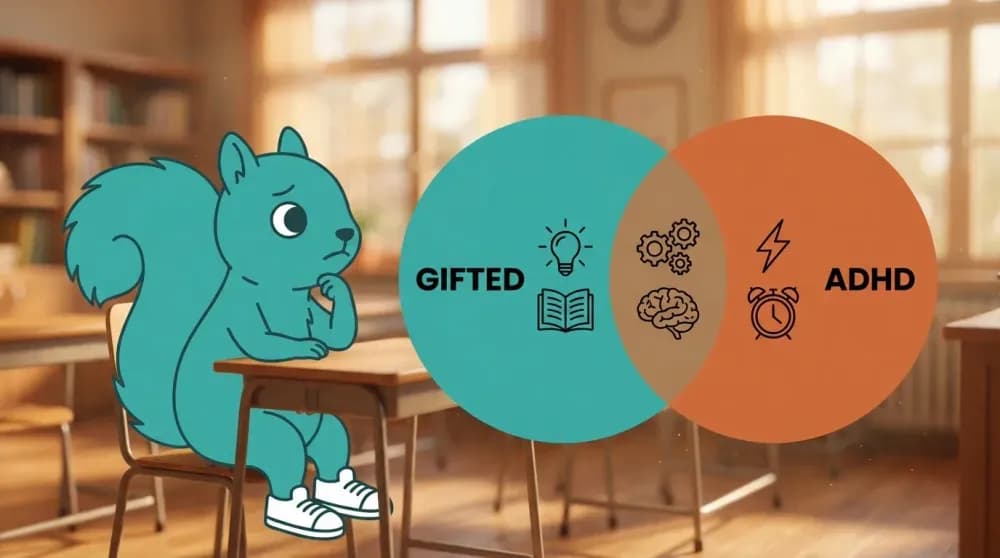
Is your child gifted, ADHD, or both? Learn the key differences between gifted ADHD behaviors, overexcitabilities, and when to get a neuropsych evaluation.
Your kid refused to use the Common Core partial quotients method for long division because — as he explained to his math teacher for ten minutes — it's computationally incomplete and doesn't generalize to polynomial division. He'd derived his own algorithm that weekend and wanted to teach it to the class. The note home said "disruptive and argumentative." That evening, he couldn't find his shoes. They were on his feet.
You've Googled some version of this at 11 PM: "my child is smart but can't get it together." Or maybe "gifted child behavior problems." Or the one that changes everything: "is my child gifted or ADHD?"
Here's the answer nobody gave you at the pediatrician's office: it might be both. And the fact that nobody mentioned that possibility is a systemic failure, not a gap in your parenting.
In brief: Gifted behaviors and ADHD symptoms overlap so significantly that even trained clinicians misidentify them. An estimated 25-50% of gifted children diagnosed with ADHD may not meet the actual diagnostic criteria — and just as many truly ADHD kids have their giftedness completely overlooked. The single most important differentiator is context: does the behavior happen everywhere, or only when the environment doesn't match the brain? This article explains what's actually happening, how to tell the difference, and why a comprehensive evaluation — not a behavior checklist — is the only reliable path to answers.
The Gifted-ADHD Overlap Is Real — and It Fools Everyone
Let's start with the uncomfortable truth: the behaviors that get a gifted child referred for an ADHD evaluation are often the same behaviors that signal giftedness in the first place.
Intense energy. Can't sit still. Blurts out answers. Argues with the teacher. Interrupts constantly. Gets bored and checks out. Hyperfocuses on interests but can't sustain attention on assigned work. Emotionally intense. Physically restless.
Read that list to a teacher and they'll say ADHD. Read it to a gifted specialist and they'll say overexcitability. Read it to a neuropsychologist who understands both and they'll say: "I need more information."
The research confirms the confusion isn't just anecdotal. A 2022 study in Brain Sciences found that the Conners rating scale — one of the most widely used ADHD screening tools — could not reliably distinguish between gifted children with ADHD and children who had ADHD alone. Classification accuracy for the gifted/ADHD group was just 72%. In a diagnostic system where parents are told "the checklist says ADHD," that margin of error means a lot of families getting incomplete answers.
And the scale of the problem is significant. Gifted psychologist James T. Webb estimated that 25-50% of gifted children diagnosed with ADHD may fail to meet the actual diagnostic criteria when comprehensively evaluated. That's not a rounding error. That's potentially hundreds of thousands of children carrying a diagnosis that doesn't fully explain what's happening — or missing a diagnosis they actually need.
Overexcitabilities: What Gifted Behaviors Look Like (and What They Get Mistaken For)
Polish psychologist Kazimierz Dabrowski identified five forms of heightened neurological intensity he called overexcitabilities — innate traits consistently found in gifted individuals. Each one mimics a clinical diagnosis so closely that the misidentification rate shouldn't surprise anyone.
Psychomotor overexcitability looks like ADHD hyperactivity. Constant movement, rapid speech, boundless physical energy. The child who taps, fidgets, paces while thinking, and cannot sit still during a lesson about something they already understand. But here's the diagnostic clue: this restlessness often disappears during deep engagement. The child who can't sit still during fractions is motionless for three hours building redstone circuits. ADHD hyperactivity tends to be more pervasive — present even during preferred activities.
Intellectual overexcitability looks like ADHD inattention — or defiance. Relentless questioning. "But why does it work that way?" asked for the ninth time, not to be difficult, but because this brain physically cannot apply a rule it doesn't understand. Obsessive deep-dives into topics that fascinate them. A flat refusal to engage with work that's intellectually beneath them — not because they're lazy, but because a brain running on genuine intellectual hunger cannot fake engagement any more than you can fake being hungry. Repetitive drill-style homework is particularly unbearable — being asked to do 30 problems demonstrating a concept they understood in 2 isn't reinforcement, it's punishment. These are the kids who derive their own algorithms and try to teach them to their teachers. The note home says "won't do the work." The reality is the work won't do anything for them.
Emotional overexcitability looks like anxiety or a mood disorder. Intense reactions to perceived injustice — the child who melts down over a playground rule that isn't fair. Deep empathy that absorbs other people's distress. Stomachaches before school. But also: moral reasoning that's years ahead of their age, and an emotional depth that, when it's not being pathologized, is extraordinary.
Sensory overexcitability looks like sensory processing issues. Tags in shirts are unbearable. The cafeteria is overwhelming. Certain textures trigger gagging. The same sensitivity that makes the world too loud also makes this child profoundly moved by music, acutely aware of visual details nobody else notices.
Imaginational overexcitability looks like ADHD inattentive type. Daydreaming. "Not paying attention." Except the child was paying attention — to the elaborate scenario unfolding inside their head, which was considerably more engaging than the lesson. This is the same trait that produces original creative thinking. It just happens to be incompatible with a classroom that needs thirty kids on the same page.
These overexcitabilities are not disorders. They're markers of developmental potential — described by Dabrowski as a brain that "sees reality in a different, stronger and more multisided manner." The problem isn't the intensity. It's that the environment wasn't designed for it.
For a deeper look at how overexcitabilities interact with neurodevelopmental diagnoses, see our guide to twice-exceptional (2e) children. Twice exceptional (2e) describes children who are both intellectually gifted and have a neurodevelopmental condition like ADHD, autism, or a learning disability — and the interplay between the two creates a profile that neither label captures alone.
The One Question That Separates Gifted from ADHD
Here's the differentiator that separates gifted behaviors from ADHD — and it's deceptively simple:
Does this happen everywhere, or only in specific situations?
A gifted child who is inattentive, restless, and emotionally reactive in an under-stimulating classroom but focused, calm, and regulated during activities that match their intellectual level is showing you an environmental mismatch, not a neurological disorder. The brain works fine on the right track. It breaks down on the wrong one.
A child with ADHD shows attention regulation difficulties across contexts — at home, at school, during preferred activities, during non-preferred activities. Even when engaged in something they love, they may still struggle with impulsivity, physical regulation, or losing track of time in ways that go beyond typical absorption. The challenges are chronic and consistent, not situational.
A child who is both gifted and ADHD — twice exceptional — shows a more complex pattern: extraordinary capacity in some domains, genuine neurological challenges in others, and a frustrating inconsistency that doesn't fit neatly into either category alone. These children often know they're capable of more and can't figure out why something is blocking them. That self-awareness, combined with the inability to overcome it through effort alone, produces a specific kind of distress that neither "gifted" nor "ADHD" fully explains.
The context question isn't just a helpful heuristic — it's what the research points to as the most reliable clinical differentiator. The Davidson Institute, CHADD, and SENG all emphasize that context-dependent behavior patterns are the strongest signal for distinguishing giftedness from ADHD in children who present with overlapping traits.
Three Ways Gifted ADHD Misdiagnosis Happens
When a gifted child with attention challenges enters the diagnostic pipeline, three things can happen — and all three lead to incomplete answers:
Scenario 1: Giftedness masks the ADHD. The child compensates through sheer cognitive horsepower. They're smart enough to wing it through elementary school — messy backpack, lost homework, but grades are fine because they absorb information fast enough to stay afloat. Then middle school hits. The organizational demands spike. The compensation strategy collapses. Parents describe it as "hitting a wall." It's not a wall — it's a coping mechanism that ran out of road.
Scenario 2: ADHD masks the giftedness. The disability is all anyone sees. The child who can't sit still, can't organize, can't finish assignments gets an ADHD label and accommodations for the challenges — but nobody tests for giftedness because the behavior doesn't look "gifted." The 99th-percentile reasoning is invisible behind the 15th-percentile processing speed. The child gets support for their weaknesses and no access to their strengths.
Scenario 3: Both mask each other. This is the cruelest version. The giftedness compensates for the ADHD enough to prevent academic failure, and the ADHD suppresses the giftedness enough to prevent academic excellence. The child looks average. "He's fine. He's just not trying." He's not fine. He's working three times harder than anyone realizes to produce results that look unremarkable — and he's exhausted.
There's also a gender dimension nobody talks about. Girls with gifted ADHD are diagnosed an average of 5 years later than boys, because inattentive-type ADHD in gifted girls is the most under-identified combination in child psychology. The gifted girl who daydreams, compensates through social skills, and internalizes her struggles doesn't match the "disruptive boy" template — so she gets missed entirely.
A 2024 study in Education Sciences found that approximately 1 in 9 students currently in gifted programs should be classified as twice exceptional based on their achievement profiles. The undercount is the story — and it means there are children sitting in classrooms right now whose full cognitive picture has never been seen.
Gifted vs. ADHD vs. Both: What to Actually Look For
You don't need a clinical degree to start noticing the patterns. Here's what to watch for — and what each pattern might be telling you.
Signs That Suggest Giftedness (Not ADHD)
- Inattention appears only in unchallenging environments; deep focus on self-selected interests
- Questions go beyond age expectations — not just "why" but "why does that why work that way"
- Emotional intensity is tied to specific triggers: injustice, existential themes, perfectionism
- Physical restlessness stops when intellectually engaged
- Learns voraciously in areas of interest without being taught
- Questions rules based on logical reasoning, not defiance — they need to understand why before they can comply
Signs That Suggest ADHD (Not Just Giftedness)
- Attention difficulties across all settings, including interesting ones
- Consistent loss of belongings, forgotten instructions, missed steps in routines
- Physical restlessness persists even during preferred activities
- Emotional reactions with slow recovery time, regardless of context
- Difficulty with transitions and task-switching even between two things they enjoy
- Chronic time perception challenges — not just "being in the zone" but genuinely unable to feel time passing
Signs That Suggest Both (Twice Exceptional)
- Exceptional performance in 1-2 areas while struggling unexpectedly in others
- A significant gap between what they can think and what they can produce — explains quantum mechanics at the dinner table, can't write a paragraph about their weekend
- Frustration and anxiety because they know they're capable but can't figure out what's blocking them
- Can sometimes hyperfocus, but still struggles with impulsivity and physical regulation even during preferred activities
- Perfectionism coupled with avoidance — won't start something they might not do perfectly
- Other people's descriptions of the child sound like they're describing two different kids
Quick Comparison: Gifted vs. ADHD vs. Both
| Behavior | Gifted | ADHD | Both (Twice Exceptional) |
|---|---|---|---|
| Inattention | Only in unstimulating environments | Across all contexts | Mixed — depends on domain |
| Hyperfocus | Deep, sustained, self-directed | Inconsistent, often on novel stimuli | Present but paired with impulsivity |
| Physical restlessness | Stops when intellectually engaged | Persists even during preferred tasks | Variable |
| Emotional intensity | Tied to specific triggers (injustice, perfectionism) | Slower recovery, context-independent | Knows they're capable but can't perform |
| Questions authority | Logical reasoning — needs to understand "why" | Impulsive blurting | Both |
| Time perception | Normal (may lose track when absorbed) | Chronically impaired | Impaired |
| Working memory | Typically strong | Typically weak | Strong in some domains, weak in others |
Key takeaway: The most reliable differentiator between giftedness and ADHD is context. If the behavior only appears in understimulating environments, it's likely giftedness. If it appears across all settings — including preferred activities — ADHD is more likely. If the pattern is inconsistent and domain-specific, consider both.
Why Standard ADHD Evaluations Miss Twice-Exceptional Kids
Here's where most families go wrong — not through any fault of their own, but because the diagnostic system wasn't built for this.
A standard ADHD evaluation typically involves a parent interview, a teacher questionnaire, and a behavior rating scale like the Conners or Vanderbilt. These tools were designed to identify ADHD in neurotypical populations. They were not designed to distinguish ADHD from giftedness — and as the research shows, they can't.
What you need is a comprehensive neuropsychological evaluation: 6-10 hours of testing across cognitive ability, processing speed, working memory, executive function, academic achievement, and emotional functioning. This is the evaluation that reveals the scatter pattern — the signature of twice-exceptionality.
In a 2025 systematic review in Frontiers in Education, researchers found that the gap between general reasoning ability and processing speed in gifted/ADHD children was nearly twice as large as in children with ADHD alone. Working memory shows a similar split — often strong in gifted ADHD children for verbal reasoning but weak for rote sequencing tasks. These gaps are diagnostic gold — the fingerprint of a brain that thinks at one speed and produces at another. But you only see it if you test for it.
What to Ask a Prospective Evaluator
These questions will tell you whether the evaluator understands the overlap:
- "Do you have experience with twice-exceptional children?" If they haven't heard the term, keep looking.
- "Will you analyze subtest scores individually, or rely on composite IQ?" The composite hides the scatter. You need the full profile.
- "Do you assess executive function separately from IQ?" Executive function is where the 2e gap lives.
- "Will the report include recommendations for both accommodations AND enrichment?" If they can only think in one direction, they'll miss half the picture.
A full neuropsych evaluation typically costs $2,000-$6,000 and is often not covered by insurance. It's expensive. It's also the single most valuable document you'll ever have for your child's education — the one that turns "we think something's going on" into "here's exactly what's happening and here's what to do about it." Our twice-exceptional guide includes a detailed walkthrough of how to find the right evaluator and what to expect from the process.
One More Thing the System Doesn't Tell You
There's a compounding factor that rarely makes it into the conversation: the relative age effect. The relative age effect is the documented pattern where the youngest children in a grade cohort are significantly more likely to be diagnosed with ADHD — because developmentally normal immaturity looks like pathology when compared to older classmates. A 2025 meta-analysis found that the youngest children in their grade are 38% more likely to receive an ADHD diagnosis than the oldest — because developmentally normal immaturity in a five-year-old born in August looks like ADHD when compared to a six-year-old born in September. The effect is driven by teacher referrals, not parent observations. If your child is young for their grade and gifted and showing intensity behaviors, the deck is stacked toward a diagnosis that may not be accurate.
This isn't an argument against ADHD as a real condition — it is real, it is neurological, and it affects roughly 1 in 9 U.S. children. It's an argument for comprehensive evaluation over quick diagnosis, and for trusting the instinct that brought you to this article in the first place: something doesn't add up, and I need someone who can see the whole picture.
Where to Start
If you recognized your family in these paragraphs — the brilliant kid who can't find his shoes, the note home that says "disruptive" when you know he was just trying to understand — here's what we'd say:
You're not imagining it. The overlap between giftedness and ADHD is well-documented, and the fact that you're searching for answers means your instincts are working exactly as they should.
Start with observation. Before pursuing any evaluation, spend two weeks noticing the context. When does the behavior appear? When does it disappear? Is the restlessness situational or pervasive? Is the emotional intensity tied to specific triggers or constant? Write it down. This observational data is more valuable to a good evaluator than any rating scale.
Find the right evaluator. A comprehensive neuropsychological evaluation with someone who understands both giftedness and ADHD is the path to clarity. Not a behavior checklist. Not a fifteen-minute pediatrician visit. The full picture.
And give yourself a break. You've been navigating a system that wasn't designed for your child's brain. The fact that you're here, reading this, trying to understand — that's not helicopter parenting. That's a parent who knows their kid better than any checklist does.
Frequently Asked Questions
Can a child be both gifted and have ADHD?
Yes. Giftedness and ADHD are not mutually exclusive — they co-occur at roughly the same rate as ADHD in the general population (about 9-10%). A child can have verbal reasoning in the 99th percentile and genuine ADHD that impairs executive function, attention regulation, and time perception. The two interact in complex ways: giftedness can mask ADHD through cognitive compensation, while ADHD can mask giftedness by suppressing academic output. Children who are both are called twice exceptional (2e).
How can I tell if my child is gifted or has ADHD?
The most reliable differentiator is context. Gifted children typically show attention and behavior challenges only in understimulating environments — they focus intensely on self-selected interests and struggle only when the environment doesn't match their intellectual level. ADHD presents across all contexts, including preferred activities. However, many children are both, which creates a mixed pattern. A comprehensive neuropsychological evaluation — not a behavior checklist — is the only reliable way to distinguish between the two or identify both.
What is the misdiagnosis rate for gifted children with ADHD?
Researcher James T. Webb estimated that 25-50% of gifted children diagnosed with ADHD may not meet the full diagnostic criteria when comprehensively evaluated. Misdiagnosis goes both directions: gifted traits are mistaken for ADHD, and genuine ADHD is missed because giftedness compensates for it. Standard behavior rating scales were not designed to distinguish between the two and have limited accuracy for this population.
What does twice exceptional (2e) mean?
Twice exceptional (2e) describes a child who is both intellectually gifted and has a neurodevelopmental condition such as ADHD, autism, or a learning disability. These children show extraordinary ability in some areas while genuinely struggling in others — and the two conditions interact in ways that make both harder to identify.
The gifted side can mask the disability through cognitive compensation, while the disability can suppress the giftedness enough to make the child appear average. A comprehensive neuropsychological evaluation is typically needed to identify both conditions and create an appropriate support plan. Learn more in our guide to twice-exceptional children.
When should I get my child evaluated?
Consider a comprehensive evaluation if your child shows a significant gap between what they can clearly understand and what they can produce; if they compensated through earlier grades but are now struggling; if their behavior at school doesn't match what you see at home during chosen activities; if you've been told "they're too smart to have ADHD" or "they just need to try harder"; or if the standard ADHD diagnosis doesn't seem to explain the full picture. A full neuropsychological evaluation (6-10 hours, typically $2,000-$6,000) reveals the cognitive profile that identifies both giftedness and ADHD. It's also the key that opens every other door — IEPs, 504 plans, gifted program access, therapeutic interventions, and school accommodations all require the kind of documentation that only a comprehensive evaluation provides. Without it, you have observations and instincts. With it, you have data the system has to respond to.
What is the relative age effect on ADHD diagnosis?
The relative age effect is the documented finding that the youngest children in a grade cohort are significantly more likely to receive an ADHD diagnosis than the oldest — by as much as 38% according to a 2025 meta-analysis. This happens because developmentally normal immaturity in younger students looks like ADHD when teachers compare them to classmates who are up to a year older. The effect is driven by teacher referrals, not parent observations. For gifted children who are already intense and restless, being young for their grade compounds the risk of misdiagnosis.
Who should evaluate my child for giftedness and ADHD?
A pediatric neuropsychologist — not a general psychologist or pediatrician. A neuropsychological evaluation is comprehensive (6-10 hours across cognitive ability, processing speed, working memory, executive function, and academic achievement), while standard ADHD screenings use behavior checklists that cannot distinguish giftedness from ADHD.
Look for evaluators with specific experience in twice-exceptional children. Key directories:
- ABPP Directory — Board-certified specialists in clinical neuropsychology, including a Pediatric subspecialty
- AACN Directory — Board-certified clinical neuropsychologists, filterable by pediatric specialty
- Psychology Today "Neuropsych Testing" — Broader directory; verify credentials
Ask any prospective evaluator: "Do you have experience with twice-exceptional children?" If they haven't heard the term, keep looking. The evaluation typically costs $2,000-$6,000 and is often not covered by insurance, but it's the document that turns "we think something's going on" into "here's exactly what's happening." See our detailed guide to finding a neuropsychologist for the full walkthrough.
References
Misdiagnosis & Diagnostic Overlap
- Webb, J.T., Amend, E.R., Beljan, P., et al. (2016). Misdiagnosis and Dual Diagnoses of Gifted Children and Adults (2nd ed.). Great Potential Press. [25-50% misdiagnosis estimate]
- Francois-Sevigny, F., Pilon, C., & Gauthier, B. (2022). "Differences in Parents' and Teachers' Perceptions of Gifted/ADHD vs. ADHD Children." Brain Sciences, 12(11), 1571. [Rating scale classification accuracy]
- Webb, J.T. & Latimer, D. (1993). "ADHD and Children Who Are Gifted." SENG. [Original overlap behavior analysis]
Twice-Exceptional Identification
- Rizzo, A., Pinnelli, S., & Minnaert, A. (2025). "Twice-Exceptional Students: A Systematic Review." Frontiers in Education. [GAI vs. FSIQ, processing speed differentiator]
- Beretta, V. & Pfeiffer, S.I. (2024). "Prevalence of Twice-Exceptional Students." Education Sciences, 14(10), 1048. [1 in 9 underidentification finding]
- Davidson Institute. "Gifted, ADHD, or Both?" [Context-dependent behavior as key differentiator]
Dabrowski's Overexcitabilities
- Daniels, S. & Piechowski, M.M. (2009). Living with Intensity. Great Potential Press. [Five overexcitabilities framework]
- SENG. "Overexcitability and the Gifted." [OE descriptions and gifted markers]
ADHD Prevalence & The Relative Age Effect
- CDC/NCHS Data Brief No. 499 (2024). ADHD prevalence: 11.4% of U.S. children ages 3-17.
- PMC (2025). "The Relative Age Effect on ADHD: A Systematic Review and Meta-Analysis." [38% higher diagnosis rate for youngest in grade]
Expert Resources
- Child Mind Institute. "Twice-Exceptional Kids: Both Gifted and Challenged."
- CHADD. "Giftedness & ADHD: A Strengths-Based Perspective and Approach."
- Lovecky, D.V. (2023). Different Minds: Gifted Children with ADHD, ASD, and Other Dual Exceptionalities (2nd ed.). Jessica Kingsley Publishers.
Topics
Why we wrote this
We didn’t write this article because we researched a market opportunity. We wrote it because we lived it — the years of “he’s just not trying,” the neuropsych evaluation that finally explained everything, the domain-by-domain work of helping a neurodivergent child build the executive function scaffolding that school never provided.
Then we built Squirrel — an executive function platform designed from the inside — because the gaps in executive function aren’t just about missed homework and lost shoes. They’re the root of the social isolation, the emotional dysregulation, and the slow erosion of confidence that neurodivergent people carry long after childhood. We built the tool we wished we’d had.
Join the Beta